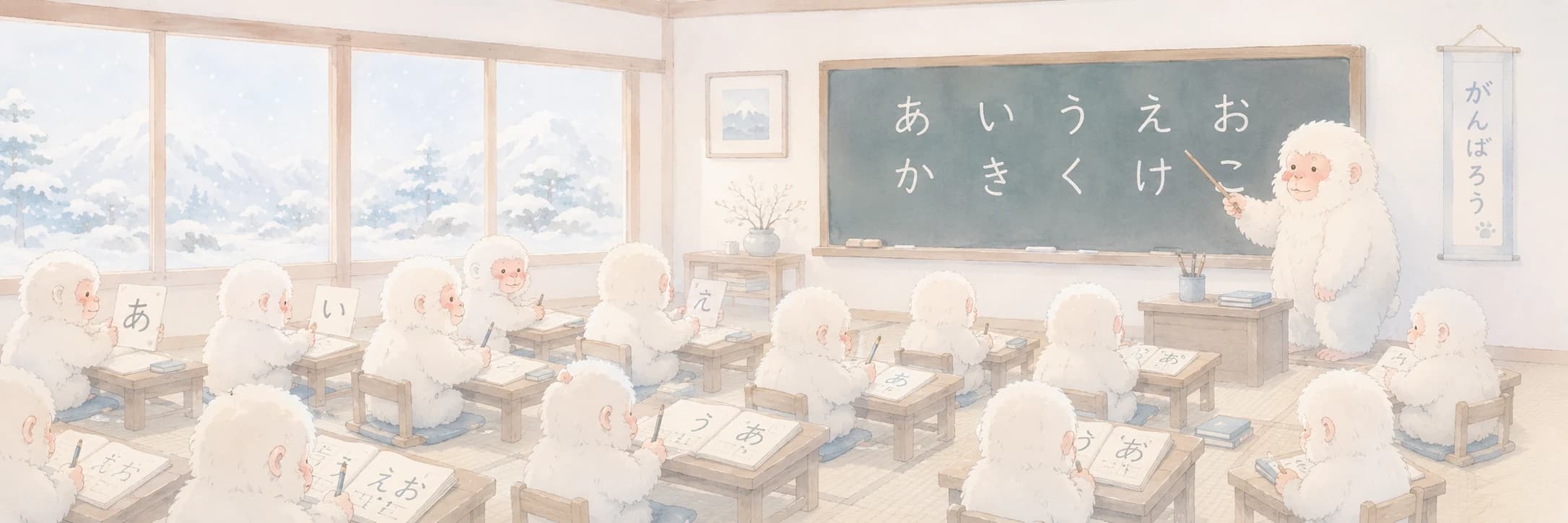
Japanese has three writing systems: hiragana, katakana, and kanji. The first two are phonetic — each character is one sound, and there are only 46 of each. Kanji is the big one (more on that in another guide). Hiragana and katakana, together called kana, are the foundation. You'll learn them quickly and use them every single day.
Why two scripts for the same sounds?
Both kana scripts encode the same set of 46 sounds. The split is stylistic and historical — they evolved separately from shorthand simplifications of Chinese characters in the 9th century. Today the convention is:
- Hiragana (ひらがな) — curvy, rounded shapes. Used for native Japanese words, particles, verb endings, and words that can be written in kanji but aren't (often for simplicity or stylistic effect).
- Katakana (カタカナ) — angular, sharp shapes. Used mainly for foreign loanwords, scientific names, onomatopoeia, and emphasis (like italics in English).
So コーヒー (kōhī, "coffee") is katakana — it's a loanword from English. たべる (taberu, "to eat") would be hiragana — though in practice it's usually written 食べる, with the kanji 食 for "eat" and the hiragana べる for the verb ending.
The 五十音 (gojūon) — "fifty sounds"
Both scripts are organized in a 5×10 grid. Five vowels (a, i, u, e, o) crossed with ten consonants. Of the 50 cells, 46 are filled (a few sounds dropped out historically). The grid is the structure you should learn — once you internalize the row × column system, you can predict every conjugation, every dakuten, every combination.
Hiragana
| — | あ | い | う | え | お |
|---|---|---|---|---|---|
| k | か | き | く | け | こ |
| s | さ | し | す | せ | そ |
| t | た | ち | つ | て | と |
| n | な | に | ぬ | ね | の |
| h | は | ひ | ふ | へ | ほ |
| m | ま | み | む | め | も |
| y | や | · | ゆ | · | よ |
| r | ら | り | る | れ | ろ |
| w | わ | · | · | · | を |
| n | ん | · | · | · | · |
Katakana
| — | ア | イ | ウ | エ | オ |
|---|---|---|---|---|---|
| k | カ | キ | ク | ケ | コ |
| s | サ | シ | ス | セ | ソ |
| t | タ | チ | ツ | テ | ト |
| n | ナ | ニ | ヌ | ネ | ノ |
| h | ハ | ヒ | フ | ヘ | ホ |
| m | マ | ミ | ム | メ | モ |
| y | ヤ | · | ユ | · | ヨ |
| r | ラ | リ | ル | レ | ロ |
| w | ワ | · | · | · | ヲ |
| n | ン | · | · | · | · |
Modifications: dakuten, handakuten, yōon
The 46 base sounds expand to about 100 once you add three modification systems. Each is mechanical — once you know the base character, the modified versions follow rules.
Dakuten (゛) — voicing
Two small marks in the upper right turn unvoiced consonants into voiced ones: k → g, s → z, t → d, h → b. So か (ka) becomes が (ga). す (su) becomes ず (zu). と (to) becomes ど (do). The shape is the same; only the marks change.
| Base | Voiced | Sound |
|---|---|---|
| か | が | ka → ga |
| さ | ざ | sa → za |
| た | だ | ta → da |
| は | ば | ha → ba |
Handakuten (゜) — only on h-row
A small circle in the upper right, used only on the h-row. It turns h into p. So は (ha) becomes ぱ (pa).
Yōon (拗音) — combinations with small や/ゆ/よ
Some sounds can't be written with a single kana. To write kya, you write き (ki) followed by a small ゃ: きゃ. The small ゃ shrinks the い vowel and grafts on the y-glide. The same applies to ゅ (shrinks ki to make kyu) and ょ (kyo).
| Combination | Reading | Example |
|---|---|---|
| きゃ | kya | 客 → きゃく (kyaku, customer) |
| しゅ | shu | 主 → しゅ (shu, master) |
| ちょ | cho | ちょっと (chotto, a bit) |
Small つ — the geminate consonant
A small っ doesn't make a sound itself — it doubles the next consonant. がっこう (gakkō, "school") has two k sounds with a tiny pause between them. In transliteration this shows up as a doubled consonant (kk, tt, pp, ss).
Long vowels
Vowels can be lengthened — pronounced for roughly twice as long. A long vowel is a different word from a short one (おばさん obasan = "aunt"; おばあさん obāsan = "grandmother"). In hiragana, long vowels are written with an extra vowel character; in katakana, with a horizontal dash ー. The vowel お is lengthened by adding う after it in hiragana. Even though the second character is written as う, it is usually pronounced as a continuation of the お sound, not as a separate “u.” So おう is pronounced like a long ō sound.
| Hiragana | Katakana | Meaning |
|---|---|---|
| おかあさん | — | okāsan, mother |
| — | コーヒー | kōhī, coffee |
| — | ゲーム | gēmu, game |
How to actually learn them
The single most efficient approach is brute force in short bursts. Hiragana takes most learners about a week of dedicated effort; katakana follows about a week later. Don't try to learn both simultaneously, a better approach is to dedicate yourself to learning katakana once you feel steadfast in your hiragana reading abilities.
- Spend 15-20 minutes a day for a week drilling hiragana recognition in our kana study tab. You'll find that it is simple enough, unlock rows by doing the corresponding lessons and then drill your knowledge base using multiple choice and text-input quizzes.
- Once you can read all 46 quickly (less than two seconds per character), start reading actual hiragana content: children's books, NHK Easy News, the "Tofugu" hiragana article. Don't translate — just read.
- Repeat the same week of effort with katakana. Loanwords from English (your name in katakana is a fun first task) are highly motivating because they sound like cognates.
One last word on rōmaji
Rōmaji is Japanese written in the Latin alphabet — what we use in this guide for readings (taberu, sushi, ikimasu). It's a useful teaching tool but a learning trap. Once you can read kana, drop rōmaji entirely. Yukimoji never shows you rōmaji inside a card, and you should treat reading without it as your default mode as soon as you can.